
TRIMUI Brick Hammer Retro Handheld Game Console Review: Metal Build, Modern Screen, Retro Soul
The TRIMUI Brick Hammer Retro Handheld Game Console combines a compact vertical form factor with a CNC-machined metal body, a sharp 3.2-inch IPS display, and Linux-based Trimui UI. It targets players who primarily enjoy 8-bit, 16-bit, and PlayStation 1-era games, prioritizing portability, durability, and a premium feel over pushing high-end emulation. This review looks at how it performs across typical retro gaming scenarios, highlighting its strengths in build quality and screen clarity, while also noting limitations such as modest ergonomics for long sessions and performance boundaries with more demanding systems.
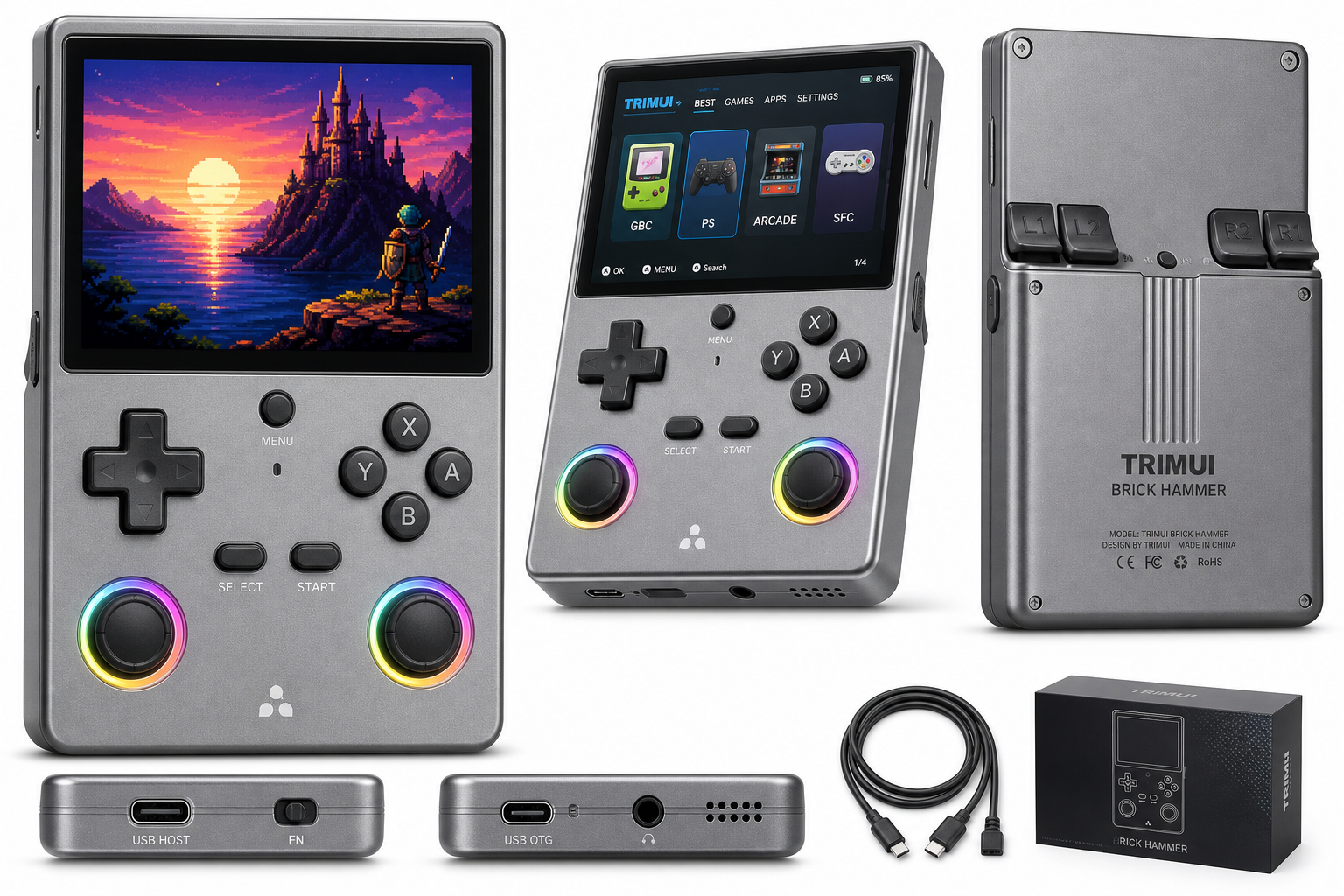
Introduction
The TRIMUI Brick Hammer Retro Handheld Game Console is a compact, vertical-style retro handheld that focuses on three main pillars: a premium CNC-machined aluminum alloy shell, a sharp 3.2-inch IPS display, and a Linux-based Trimui OS tuned for ease of use rather than deep tinkering.
Inside, it runs an Allwinner A133P quad-core CPU paired with a PowerVR GE8300 GPU and 1 GB of LPDDR3 RAM. Storage starts at 8 GB of internal eMMC and can be expanded via microSD (TF) cards up to 1 TB, giving ample room for large multi-system ROM collections.
On paper, this makes the Brick Hammer well-suited for classic 8-bit and 16-bit consoles, handheld systems (like Game Boy and Game Boy Advance), and even many PlayStation 1 titles, while remaining highly portable at around 159 g and roughly the size of a chunky old-school Game Boy.
If purchased around $117.99, it aims to sit in the middle of the retro-handheld market: not an ultra-budget plastic device, but also not a high-end powerhouse for the most demanding 3D systems.
Typical Use Cases
1. Everyday Retro Commuter Console
The Brick Hammer’s metal body and compact footprint make it a strong candidate as an everyday carry (EDC) handheld. It slips into a jacket pocket or small bag without much fuss, and the sturdy CNC aluminum shell feels resistant to scuffs and minor drops.
Best suited for:
- Game Boy, Game Boy Color, and Game Boy Advance titles
- NES and SNES-era games
- Short arcade sessions (e.g., CPS1/2, Neo Geo)
Battery life is rated around 4–5 hours depending on brightness and workload, driven by a 3000 mAh Li‑polymer battery. That’s enough for a commute, lunch breaks, and evening sessions without needing to charge mid-day.
2. Couch and Bedtime Gaming
Thanks to its 3.2-inch IPS fully laminated display with a 1024×768 resolution, text and pixel art look crisp, even when you’re holding the device relatively close. Fully laminated construction helps reduce reflections and increases perceived contrast, which is especially handy in dim indoor lighting.
For quieter environments, the Brick Hammer offers:
- Dual front-facing stereo speakers (0.5 W x2)
- A bottom 3.5 mm headphone jack for private listening
This combination makes it comfortable for couch or bed gaming sessions where you want clear audio without blasting a TV or soundbar.
3. Local Multiplayer and Casual Competitive Play
The Brick Hammer includes Wi‑Fi (802.11 b/g/n) and Bluetooth 2.1 + EDR/4.2 support. While it’s not a full-fledged online platform, it can support local wireless battles and external controllers via USB host mode.
Typical scenarios:
- Two-player battles in supported emulators over Wi‑Fi
- Plugging in a USB controller via the top USB-C host port for a couch-style setup
This turns the handheld into a small emulation station where the console functions as both display and host, or as a dedicated controller screen while outputting sound locally.
4. On-the-Go Retro Library with Expandable Storage
With 8 GB of internal storage and TF card support up to 1 TB, the Brick Hammer is intended to carry large multi-system ROM sets. This is especially useful if you:
- Maintain separate ROM sets for multiple generations (e.g., 8-bit, 16-bit, PS1)
- Want to install multiple frontends or OS builds on different SD cards
USB OTG support (bottom USB-C) also means you can copy files via standard flash drives formatted in FAT32, which can simplify moving ROMs between PC and console.
Performance in Each Scenario
Retro Consoles (8-bit and 16-bit)
For systems like NES, SNES, Mega Drive/Genesis, Game Boy, Game Boy Color, and Game Boy Advance, the Brick Hammer performs strongly.
- Emulation accuracy and stability: Most mainstream cores handle these systems comfortably on the A133P, and the device runs them without notable slowdowns in typical titles.
- Visual quality: The 400+ PPI 3.2-inch IPS panel and high 1024×768 resolution give plenty of room for scaling and shaders. Pixel art looks clean, and fine text in RPGs and strategy games remains readable.
- Input response: For old-school 2D titles, input latency feels acceptable for casual play. Very latency-sensitive players may notice a difference vs. top-tier handhelds or tuned PC setups, but for the intended audience, performance is generally solid.
Handheld Systems (GB, GBC, GBA, Others)
The Brick Hammer is almost tailor-made for classic handheld content.
- Aspect ratio: While the screen isn’t 1:1 or 4:3 exactly for all systems, the high resolution gives you flexibility for integer scaling and tasteful borders.
- Comfort: The vertical form factor mimics Game Boy-style ergonomics, making it easy to hold for one- or two-handed play for shorter sessions.
Game Boy and GBC titles in particular benefit from:
- Dense pixel structure that makes small sprites and fonts crisp
- Strong backlight and adjustable brightness, which older handhelds lack
PlayStation 1 and Similar-Era 3D Systems
The Allwinner A133P has enough headroom to run many PS1 titles at playable speeds.
- 2D-heavy PS1 games: Typically run smoothly and look excellent on the small, sharp display.
- 3D-heavy titles: Generally playable, but performance may vary depending on emulator optimization and settings. Expect occasional drops in demanding scenes.
The screen’s high resolution helps smooth out textures and polygon edges, and the form factor is still manageable, though extended 3D sessions may highlight the limitations of the small controls and vertical arrangement.
Audio, Controls, and Responsiveness
Audio:
- Dual 0.5 W stereo speakers provide adequate loudness for personal use.
- The 3.5 mm headphone jack avoids Bluetooth latency and compression artifacts if you prefer wired audio.
Controls:
- Standard ABXY face buttons, D‑pad, and shoulder buttons (L1/L2, R1/R2), with backlighting that ties into the RGB atmosphere system.
- A custom FN switch and front F1/F2 hotkeys enable quick access to system functions, such as brightness, volume, and emulator shortcuts, depending on configuration.
In general, button feel is serviceable and consistent with compact retro handhelds. Larger hands may find prolonged use tiring, especially in games that heavily rely on shoulder buttons.
Battery Life and Thermals
The 3000 mAh battery typically delivers about up to 5 hours of gameplay under moderate brightness and with 2D-focused systems. Heavier workloads (e.g., 3D titles, higher brightness, Wi‑Fi active) reduce runtime.
Metal construction helps with passive heat dissipation. The device can become warm during longer or more demanding sessions but usually avoids uncomfortable hot spots, and the aluminum shell spreads the heat more evenly than plastic.
Strengths Across Scenarios
1. Premium CNC-Machined Metal Body
The standout feature of the Brick Hammer is its CNC-machined aluminum alloy shell.
Benefits include:
- A more solid, premium feel than many plastic competitors
- Better structural rigidity and durability for travel
- Less creaking and flex, which improves perceived quality
For users who keep their handheld in a bag or carry it daily, this level of build quality is a major advantage.
2. High-Resolution, Fully Laminated IPS Display
The 3.2-inch IPS fully laminated screen with 1024×768 resolution is another clear highlight:
- High pixel density makes old games and UI elements sharp
- Fully laminated construction reduces internal reflections and improves image clarity
- Good viewing angles, which matter when playing in varied positions
This display can make even familiar retro titles feel refreshed, particularly text-heavy RPGs and strategy games that benefit from crisper fonts.
3. Flexible Storage and Format Support
With 8 GB internal eMMC plus TF card expansion to 1 TB, the Brick Hammer is designed for large ROM libraries. The OS supports over 20 retro formats, covering a wide range of classic consoles and handhelds.
This is ideal if you:
- Want a single device for the bulk of your 2D-era gaming
- Prefer to keep one card per library or region
- Frequently add or reorganize ROM sets
4. Tailored Trimui UI and Quality-of-Life Features
The Trimui UI emphasizes ease of use with features like:
- Save/load states
- Recent games lists
- Favorites bookmarking
- Hotkeys for quick access to system functions
Combined with RGB atmosphere lighting and custom backplates on some variants, the Brick Hammer also offers a level of personalization that many generic handhelds lack.
5. Balanced Portability and Capability
At about 159 g, with a small footprint and solid build, the Brick Hammer hits a sweet spot between power and portability. It doesn’t chase the heaviest systems, but it reliably handles the majority of classic 2D and early 3D libraries without being bulky.
Limitations Across Scenarios
1. Not a High-End 3D Powerhouse
While capable for PS1 and similar-era systems, the Brick Hammer’s A133P platform and 1 GB RAM limit performance for:
- Higher-end 3D consoles beyond the PS1 generation
- More advanced emulation features that require significant CPU/GPU overhead
If your focus is on demanding N64, Dreamcast, or PSP titles, you may find other handhelds more appropriate.
2. Vertical Ergonomics and Small Controls
The compact, vertical design is great for portability but less ideal for:
- Long sessions that heavily use shoulder buttons
- Players with large hands who need more grip space
Extended action-heavy or 3D sessions can lead to fatigue more quickly than on larger, more ergonomic devices.
3. Battery Life is Good, Not Exceptional
The 3000 mAh battery and efficient SoC produce respectable but not standout runtimes. Heavy users may still be charging daily, especially if mixing in Wi‑Fi features, higher brightness, or more demanding games.
4. OS Flexibility vs. Tinkerers’ Expectations
The Trimui UI is designed for quick, straightforward use. While you can customize ROM layouts and install different builds on SD cards, users who want:
- Deep system-level tweaking
- Multi-boot frontends
- Fine-grained emulator configuration per title
may find the experience less open than more hobbyist-focused platforms and open Android handhelds.
5. Pricing Relative to Plastic Competitors
At around $117.99, the Brick Hammer sits above some plastic-bodied retro handhelds that offer similar performance on paper.
What you’re paying for is primarily:
- CNC aluminum construction
- High-resolution, laminated display
- More refined fit-and-finish
If you care mainly about raw emulation per dollar and don’t need a metal shell, you can find cheaper alternatives, though they may not match the Brick Hammer’s overall feel and build quality.
Verdict
The TRIMUI Brick Hammer Retro Handheld Game Console is a thoughtfully built device that emphasizes premium materials, screen quality, and portability over chasing the high end of emulation performance.
It is particularly well-suited for:
- Players focused on 8-bit, 16-bit, and handheld classics
- Fans of PlayStation 1-era games who don’t mind performance varying with more demanding 3D titles
- Users who want an everyday carry retro handheld that looks and feels more like a premium gadget than a toy
You should consider alternatives if:
- You primarily want to emulate later-generation 3D systems
- Long, ergonomically demanding sessions are your norm
- You value maximum performance per dollar over build quality and finish
For its target audience—retro enthusiasts who want a sturdy, metal-bodied handheld with a sharp screen and convenient Trimui UI—the Brick Hammer offers a compelling balance of design, durability, and capability. At a price point around $117.99, it sits as a premium-feeling mid-range option that prioritizes the experience of holding and seeing your games as much as the emulation running underneath.