
Valve Steam Deck OLED 512GB (International Version) Review: Premium PC Gaming in a Portable Form
The Valve Steam Deck OLED 512GB (International Version) refines Valve’s handheld PC formula with a vibrant 7.4‑inch HDR OLED display, improved battery life, and faster Wi‑Fi 6E connectivity. With a 512GB NVMe SSD, 16GB of LPDDR5 RAM, and a custom AMD APU, it targets players who want a flexible, PC‑like experience on the go. This review looks at its design, display quality, performance, software, battery life, and where it excels or falls short compared with other handheld gaming options.
Introduction
The VALVE Steam Deck OLED 512GB SSD + 16GB RAM (International Version) is the most refined iteration of Valve’s handheld gaming PC to date. Building on the original LCD Steam Deck, this model focuses on three core upgrades: a larger and more dynamic 7.4‑inch HDR OLED screen, better battery life, and faster Wi‑Fi 6E for downloads and streaming.
While the core idea remains the same — a portable device that runs your Steam library under SteamOS 3.0 — the OLED refresh aims to make everyday use more comfortable and modern, with deeper blacks, higher brightness, and smoother 90Hz gameplay where supported.
If you’re considering the OLED 512GB as your first Steam Deck or as an upgrade from the LCD model, this review breaks down what you can realistically expect in day‑to‑day use.
Key Points
- Display: 7.4" HDR OLED, 1280 × 800, up to 90Hz refresh, <0.1 ms response, up to 1,000 nits peak brightness in HDR and ~600 nits in SDR.
- Processor (APU): 6 nm AMD APU with Zen 2 CPU (4 cores / 8 threads, 2.4–3.5 GHz) and 8 RDNA 2 compute units at up to 1.6 GHz.
- Memory & Storage: 16GB LPDDR5 RAM (5500 MT/s, quad 32‑bit channels) and 512GB NVMe SSD, expandable via microSD (UHS‑I, supports SD, SDXC, SDHC).
- Operating System: SteamOS 3.0 (Arch‑based Linux) with Proton compatibility layer for Windows titles.
- Battery: 50Wh battery, typically 3–12 hours of gameplay depending on workload and settings.
- Connectivity: Tri‑band Wi‑Fi 6E (2.4 / 5 / 6 GHz, 2×2 MIMO), Bluetooth 5.3, USB‑C with DisplayPort 1.4 (up to 8K@60Hz or 4K@120Hz), USB 3.2 Gen 2.
- Form factor: Handheld console with integrated controls, thumbsticks, trackpads, and a 3.5 mm headphone jack.
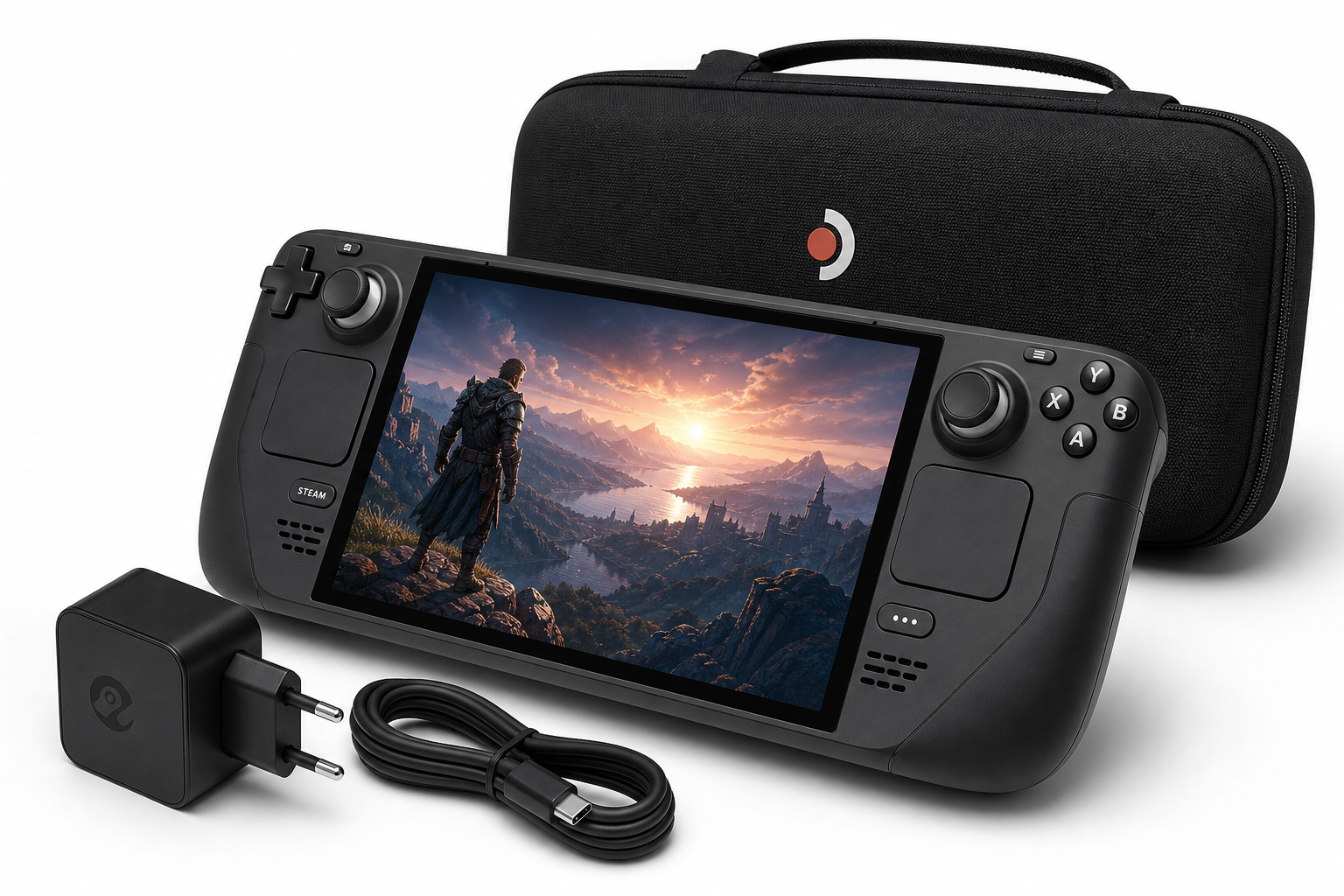
- Package (International Version): Console, USB‑C charger (non‑US plug), and a carrying case.
- Typical pricing: Often positioned as a mid‑to‑upper tier handheld PC, frequently found around $878.00 depending on region and availability.
Experience
Design and Build Quality
Physically, the Steam Deck OLED closely resembles the original Deck but with refinements that are more apparent in daily handling than in photos. The chassis remains a full‑size handheld PC rather than a compact, Switch‑sized device: it is wide, with substantial grips, but well balanced in the hands. The international version includes a carrying case, which is useful given its size and weight.
Fit and finish are solid for a device in this category. Buttons and triggers feel consistent and responsive, and the thumbsticks offer a console‑like level of precision. The addition of trackpads on each side is still a major differentiator versus competing handhelds, especially for mouse‑centric PC titles and desktop navigation.
Display: Where the OLED Shines
The move to an HDR OLED panel is the main reason to consider this model over older Steam Deck versions. The 7.4‑inch screen stretches the visible area slightly while retaining the 1280 × 800 resolution, which is well‑suited to the APU’s capabilities at this physical size.
In practical use, the OLED panel delivers:
- Deep blacks and high contrast, noticeably improving dark scenes and UI readability.
- High peak brightness that makes outdoor or bright‑room usage more feasible.
- Fast response times (<0.1 ms) that minimize motion blur.
- Up to 90Hz refresh rate, which is especially nice in less demanding games or when navigating the UI, making everything feel smoother.
Because the resolution hasn’t changed, performance remains in a sweet spot: demanding AAA titles can still target 30–40 fps with tuned settings, while indie and retro titles can run at higher frame rates that benefit from the 90Hz panel.
Performance and Game Compatibility
Under the hood, Valve continues to use a custom AMD APU with Zen 2 CPU cores and RDNA 2 graphics. The shift to a 6 nm process and power envelope tuning does not radically change performance over the original Steam Deck, but helps with efficiency and thermals.
In practice:
- Modern AAA games typically run at native 800p with a mix of medium/low settings and FSR upscaling, targeting 30–45 fps depending on the title.
- eSports and competitive games (e.g., older shooters, MOBAs) can often be tuned to 60 fps or beyond, making good use of the 90Hz screen.
- Indie, 2D, and retro titles run extremely well, often limited only by their own engines.
The 16GB of LPDDR5 RAM helps with both game performance and background tasks, providing enough headroom for modern engines and system overhead.
Storage and Expandability
The 512GB NVMe SSD feels like a practical baseline for a PC‑grade library, especially when modern AAA titles can exceed 100GB. Load times are fast and comparable to current‑gen consoles for many titles.
For users with larger libraries, microSD expansion is essential. The slot supports UHS‑I cards, and while microSD load times are slower than the internal NVMe SSD, the difference is acceptable for many games, especially less demanding or older titles.
Software: SteamOS 3.0 and Proton
Running SteamOS 3.0 (Arch‑based), the Deck OLED provides a console‑like front end tailored to Steam. The interface is optimized for controller navigation, showing your library, store, and community sections in a unified layout.
Key aspects of the software experience include:
- Proton compatibility layer, which allows many Windows‑only titles to run on Linux with minimal user intervention.
- Per‑game profiles for performance, including frame rate caps, TDP settings, and scaling options.
- The ability to switch to a full Linux desktop mode, enabling use as a small PC for browsing, media, or light productivity when paired with a dock, keyboard, and mouse.
Game compatibility is strong overall, though some titles may still require community workarounds or manual tweaks. The ecosystem continues to evolve with updates to SteamOS and Proton.
Connectivity and Docked Use
The inclusion of Wi‑Fi 6E provides more stable and faster downloads when used with compatible routers. This is helpful for managing large game downloads and updates, and can improve cloud streaming experiences.
Through the USB‑C port with DisplayPort 1.4, the Steam Deck OLED can output up to 8K@60Hz or 4K@120Hz to an external monitor (though the internal APU is realistically targeted at 1080p/1440p gaming depending on settings). When combined with a USB‑C hub or dedicated dock, the Deck can function as a compact PC, supporting peripherals, external storage, and wired networking.
Battery Life and Thermals
The 50Wh battery offers a claimed 3–12 hours of gameplay, which aligns with expectations for this class of hardware. Real‑world endurance is highly workload‑dependent:
- Demanding 3D games at higher brightness may land closer to 2.5–4 hours.
- Less demanding or 2D titles can push beyond 6 hours, especially at moderate brightness and capped frame rates.
- Video playback or light usage can approach the upper end of the range.
The more efficient 6 nm APU and OLED panel help offset the higher brightness and refresh potential, often resulting in slightly better battery life than the original LCD model under similar settings.
Thermally, the device will become warm under sustained load, but the cooling solution is designed to keep surface temperatures within comfortable limits for handheld use. Fan noise is present but generally comparable to other gaming handheld PCs.
Pros
- Excellent HDR OLED display with deep blacks, high brightness, fast response, and up to 90Hz refresh.
- Strong performance for a handheld PC, capable of running a wide range of modern and classic titles.
- 16GB LPDDR5 RAM and 512GB NVMe SSD provide a practical balance of speed and capacity for most users.
- SteamOS 3.0 delivers a console‑like UI, per‑game performance settings, and a growing compatibility list through Proton.
- Wi‑Fi 6E and Bluetooth 5.3 for modern wireless connectivity.
- Expandable storage via microSD, allowing flexible management of large libraries.
- Docking support via USB‑C/DisplayPort, enabling desktop‑style use with monitors and peripherals.
- Includes carrying case and charger, making it more travel‑ready out of the box.
Cons
- Size and weight remain closer to a small PC than a compact handheld; not as small or light as some competitors.
- Battery life still varies greatly with workload; demanding titles can drain the battery relatively quickly.
- Resolution capped at 1280 × 800, which is practical for performance but may seem modest compared with some higher‑resolution handhelds.
- Linux‑based SteamOS means a minority of games or launchers may require tinkering or may not be fully supported.
- The international version’s non‑US charger may require an adapter depending on your region.
- Pricing can be significantly above entry‑level handhelds, especially when purchased through resellers, even if the official MSRP sits around $878.00.
Verdict
The Valve Steam Deck OLED 512GB (International Version) is a well‑rounded and premium handheld gaming PC that meaningfully improves on the original LCD model. The OLED screen, enhanced battery efficiency, and Wi‑Fi 6E connectivity collectively make for a more comfortable and future‑proof portable experience.
For players heavily invested in the Steam ecosystem who want a console‑like, portable way to access a large PC library, the Deck OLED 512GB is a compelling option. It is particularly attractive if you value display quality and are comfortable with the size of a full‑fledged handheld PC.
If your budget aligns with the typical asking price of around $878.00, and you are willing to accept the trade‑offs of variable battery life and occasional software tinkering, the Steam Deck OLED 512GB stands out as one of the most capable and flexible handheld gaming devices currently available.