
PlayStation 5 Console (1TB) Review: A Leaner PS5 With Roomier Storage
The PlayStation 5 console – 1TB is Sony’s slimmer, updated PS5 with a built‑in disc drive and expanded internal storage. It targets players who want true 4K gaming, fast load times, and access to both physical and digital game libraries. This review looks at its design, hardware capabilities, game performance, noise and thermals, user experience, and the key trade‑offs versus alternatives in the PS5 lineup.
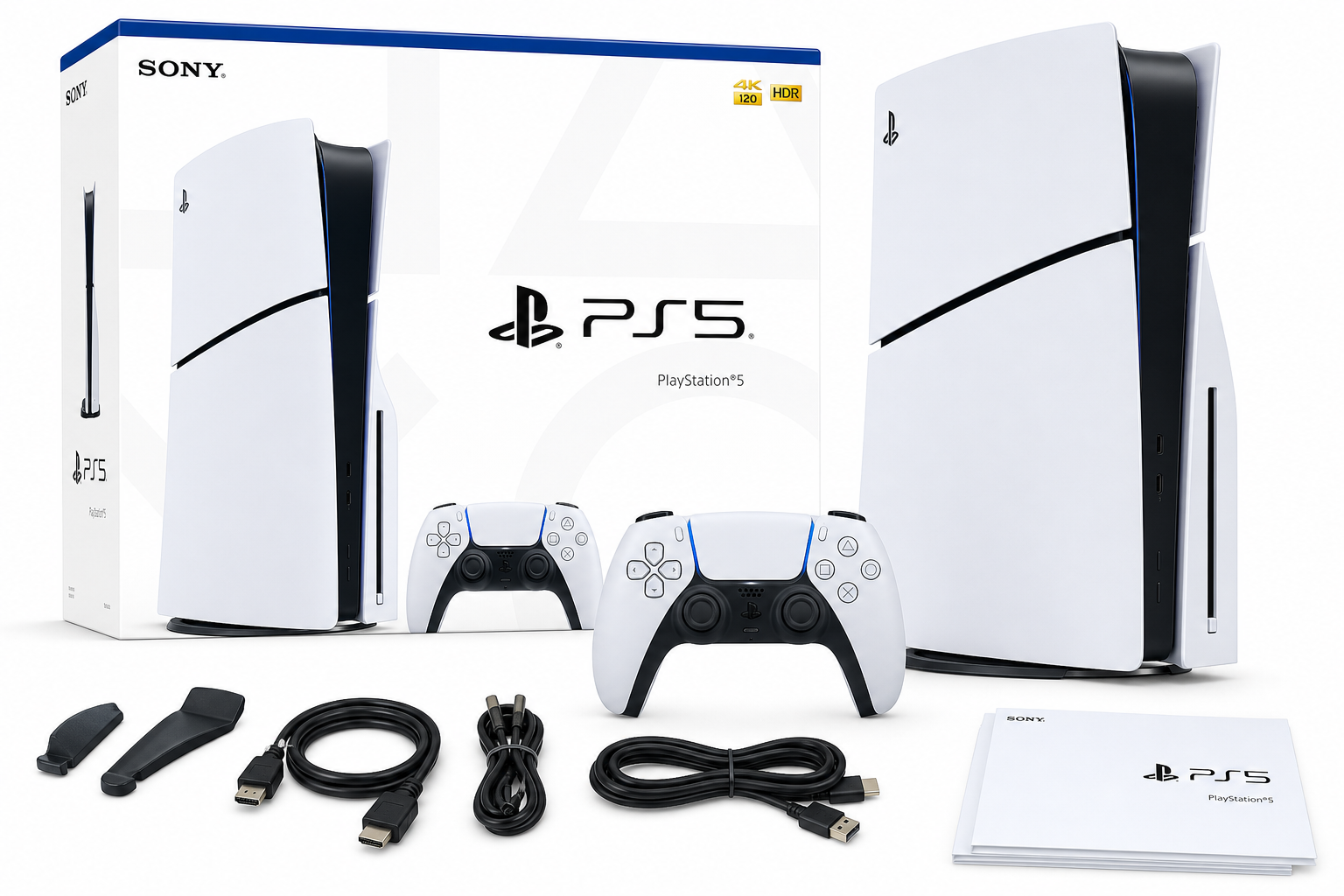
Product Context
Sony’s PlayStation®5 console – 1TB is the current disc‑equipped “slim” revision of the PS5, pairing a smaller chassis with a 1TB internal SSD and the same core architecture that defined the original launch model. It’s aimed at players who:
- Want to play both physical Blu‑ray game discs and digital titles.
- Care about fast loading, responsive controls, and 4K visuals.
- Prefer a more compact console that still fits easily in modern TV setups.
On Amazon (ASIN B0FRGTYSL5), this configuration is sold as a standard console package with a single DualSense controller and essential cables. The value you get at around $610.06 positions it as the mainstream choice for most people entering the PS5 ecosystem.
Feature Breakdown
Design and Form Factor
- Slimmer chassis: Compared with the launch PS5, this model (often referred to informally as the PS5 “Slim”) uses a more compact and lighter case while retaining the white two‑tone aesthetic and black center section.
- Integrated disc drive: Unlike the Digital Edition, this version includes a built‑in Ultra HD Blu‑ray drive for PS5 and PS4 game discs, as well as movie playback.
- Horizontal stand feet: The box includes two plastic feet for horizontal orientation; a separate vertical stand is sold separately.
Internal Hardware
Internally, this PS5 maintains the same generation of hardware as earlier models:
- CPU & GPU: Custom AMD Ryzen Zen 2 CPU paired with RDNA 2‑based graphics, designed to support high frame rates up to 120Hz and advanced rendering features like ray tracing. (playstation.com)
- Memory: 16 GB of GDDR6 shared system memory, sufficient for current AAA games at 4K with detailed textures. (playstation.com)
- Storage: 1TB custom NVMe SSD, an upgrade from the original 825GB drive, providing significantly more usable space for modern large game installs. (playstation.com)
Connectivity and I/O
- Networking: Wired Ethernet plus Wi‑Fi 6 (802.11ax) for faster and more stable wireless connections, especially useful for large game downloads and online play. (playstation.com)
- Ports: A mix of USB Type‑A and USB Type‑C high‑speed ports for accessories, storage, and charging the DualSense controller. (playstation.com)
- Video output: HDMI 2.1 output capable of 4K at up to 120Hz on supported displays.
In‑Box Contents
The standard package typically includes: (888lots.com)
- PlayStation 5 console (1TB, disc model)
- DualSense wireless controller
- 1TB SSD (internal)
- 2 horizontal stand feet
- HDMI cable
- AC power cord
- USB cable
- Printed documentation
- ASTRO’s Playroom, pre‑installed as a showcase for DualSense haptics
Performance Insights
Load Times and Responsiveness
The custom SSD remains one of the PS5’s standout features. In practice, this means:
- Very fast boot and resume times for supported titles.
- Minimal loading between levels or fast travel points in well‑optimized games.
- Smooth streaming of large game worlds with fewer texture pop‑ins compared with last‑gen consoles.
The jump from older HDD‑based systems (like PS4) is dramatic. Even compared with PS4 Pro, many games feel substantially more responsive due to both CPU and storage improvements.
Visual Quality and Frame Rates
With its RDNA 2 GPU, the PS5 targets:
- 4K output for many titles, often using temporal upscaling or reconstruction techniques.
- Ray tracing effects in supported games, typically for reflections, shadows, or lighting, at the cost of some resolution or frame rate.
- Performance modes that prioritize high frame rates (e.g., 60fps or 120fps) over visual fidelity in many modern games.
On a capable 4K HDR TV with HDMI 2.1, the console can drive:
- Up to 120Hz in compatible games.
- Variable refresh rate (VRR) support on displays that offer it, reducing tearing and stutter.
Backward Compatibility
This model supports a broad library of PS4 games, often with improved load times and more stable performance. Some PS4 titles also receive PS5‑specific patches that enhance resolution or frame rate.
Usability
Setup and Everyday Use
Initial setup is straightforward:
- Connect power and HDMI.
- Pair the DualSense controller via USB or Bluetooth.
- Follow the on‑screen configuration for language, network, and PSN account.
The interface is generally quick and intuitive once you learn the layout, with dedicated sections for games, media, and system settings.
DualSense Controller Experience
The bundled DualSense controller remains a highlight of the platform, offering:
- Haptic feedback that can simulate different textures and impacts.
- Adaptive triggers with variable resistance for actions like braking or drawing a bow.
- A built‑in microphone and improved ergonomics over the DualShock 4.
ASTRO’s Playroom is an excellent demonstration of these features and is included at no extra cost.
Noise and Thermals
The slimmer chassis still keeps fan noise modest under most gaming loads, especially compared to last‑generation consoles. While heavy AAA titles can cause the fan to ramp up, the system generally remains quiet at a normal living‑room distance.
Storage Management
With a 1TB internal SSD, users have more breathing room for large installs than on the original 825GB model. That said:
- Big AAA games with high‑resolution assets can still consume tens of gigabytes each.
- The console supports M.2 NVMe SSD expansion for those who need additional internal storage, and USB external drives for PS4 games and media.
Most typical users can comfortably maintain a rotating library without immediate need for expansion, but heavy gamers may still want to plan for an extra drive.
Trade-offs
Pros
- 1TB internal SSD offers more practical space for modern game sizes versus earlier PS5 revisions.
- Disc drive included, giving flexibility between physical and digital game purchases.
- Compact “slim” design that fits more easily into crowded entertainment centers.
- Strong performance for 4K gaming with fast load times and robust backward compatibility.
- DualSense controller adds unique haptics and adaptive triggers that some competitors lack.
Cons
- Still a sizable console compared to some other devices; may not fit in very tight shelves.
- Limited internal storage for very large libraries without adding an M.2 SSD.
- Vertical stand is not included and must be purchased separately if you prefer that orientation.
- PS5 ecosystem features and services (like cloud saves and some online multiplayer) may require additional subscriptions.
When It’s a Good Fit
The PlayStation 5 console – 1TB is well‑suited for:
- New console buyers who want a full‑featured PS5 with roomier storage and a disc drive.
- Players with existing PS4 disc collections who want to continue using them.
- Households that value both cinematic 4K single‑player experiences and responsive online multiplayer.
When You Might Consider Alternatives
You might want to look at other models or platforms if:
- You are fully committed to digital purchases and prefer a lower initial hardware cost (making a digital‑only variant more attractive when available).
- You have extremely limited physical space and need a more compact device than even the slim PS5.
- You already own a previous PS5 with sufficient storage and don’t need the form‑factor change.
Conclusion
The PlayStation 5 console – 1TB refines Sony’s flagship gaming system with a slimmer design and more internal storage while retaining the core performance that defined the PS5 generation. For most players who want a next‑gen console today with access to both physical and digital libraries, it strikes a strong balance of power, flexibility, and usability.
As long as you’re comfortable managing digital storage or eventually adding an M.2 SSD, this 1TB PS5 provides a capable, future‑facing platform for current and upcoming PlayStation titles at a competitive price point around $610.06.