
Nintendo Switch with Neon Blue and Neon Red Joy-Con: A Versatile Hybrid Console Still Worth Buying
The Nintendo Switch with Neon Blue and Neon Red Joy-Con is Nintendo’s flagship hybrid console, designed to move seamlessly between TV, tabletop, and handheld play. This review examines how well the system holds up for portable gaming, couch co‑op, family use, online play, and more. It looks at performance, Joy-Con ergonomics and motion controls, battery life, and the overall game library, while also highlighting limitations like Joy-Con drift risk, aging hardware compared to newer consoles, and modest internal storage, to help buyers decide whether this configuration is still the right entry point into the Nintendo ecosystem.
Introduction
The Nintendo Switch with Neon Blue and Neon Red Joy-Con is the best-known version of Nintendo’s hybrid console. It combines a 6.2‑inch tablet-style main unit with detachable Joy-Con controllers and a dock that connects to a TV. The result is a system that transitions between handheld, tabletop, and traditional console play with minimal friction.
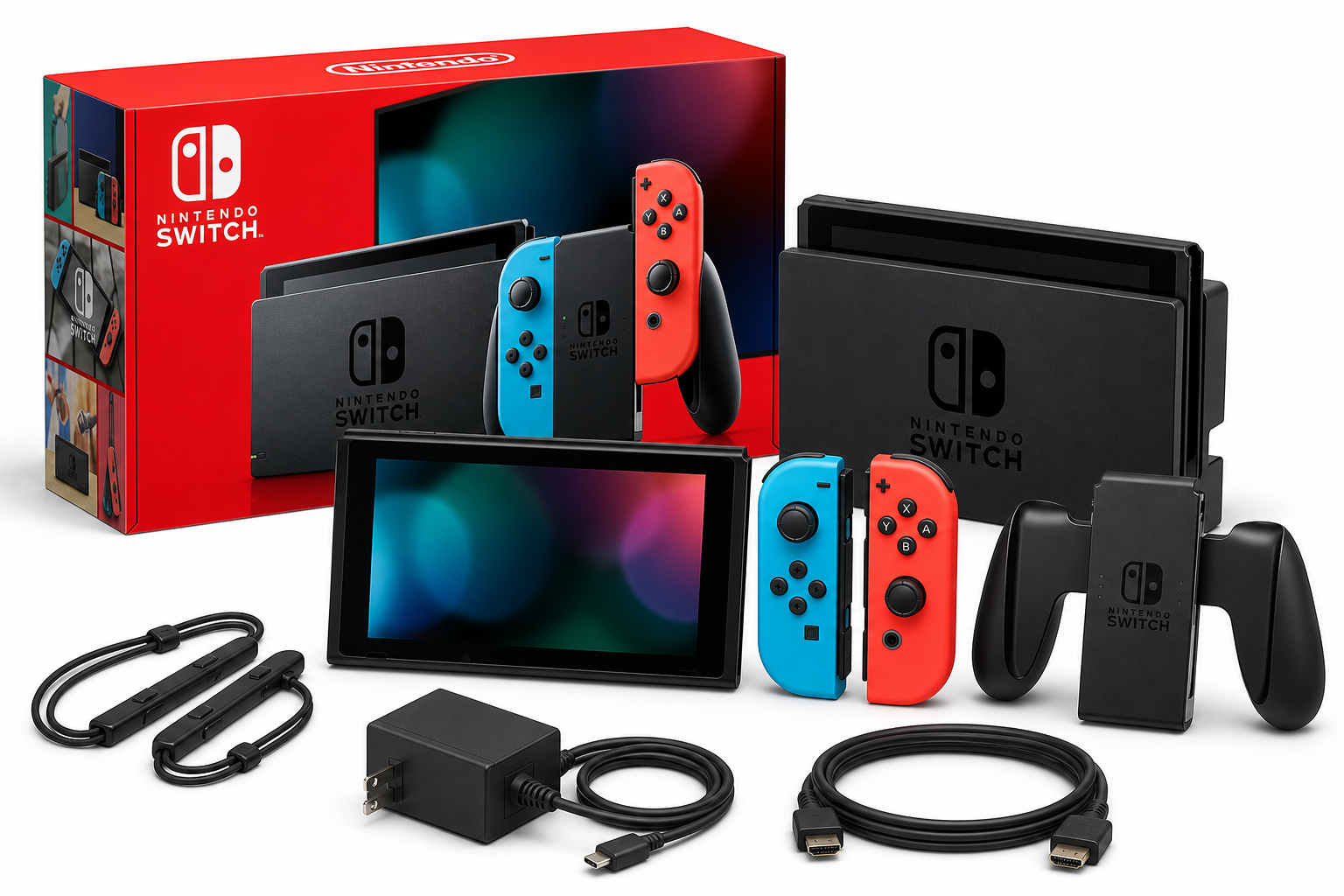
This particular configuration includes the main Nintendo Switch console, left Neon Blue and right Neon Red Joy-Con controllers, Joy-Con straps, a Joy-Con grip, the Nintendo Switch dock, HDMI cable, and AC adapter. It targets players who want one device that can work for solo portable gaming, family living‑room sessions, and local multiplayer almost anywhere.
In many regions this bundle typically sits around $325.99, which places it in the mid-range of modern consoles while offering both home and handheld play from a single purchase.
Typical Use Cases
1. Handheld Gaming on the Go
In handheld mode, the Joy-Con slide onto rails on each side of the console to form a single portable unit. This mode suits:
- Commuters and frequent travelers
- Students playing between classes
- Anyone who prefers playing on the couch or in bed rather than in front of a TV
The 6.2‑inch capacitive touchscreen and relatively compact size make the Switch reasonably comfortable to carry in a small bag or case.
2. TV Mode as a Traditional Console
Placed into the included dock, the Switch outputs to a TV and behaves like a home console. Players can use:
- Both Joy-Con attached to the grip (forming a more conventional controller)
- Each Joy-Con individually for two‑player games
- Optional Pro Controller (sold separately) for extended sessions
This is the main use case for families who want group play in the living room or anyone who prioritizes larger-screen gaming.
3. Tabletop Mode for Shared Portable Play
With its integrated kickstand, the Switch can be set on any flat surface while the Joy-Con are used wirelessly. This mode is ideal for:
- Quick multiplayer sessions in small spaces (kitchen tables, office break rooms, airplanes with trays)
- Local co‑op or competitive titles that don’t require a large display
Each Joy-Con can be turned sideways to act as a compact standalone controller, enabling two‑player gaming with the hardware included in this bundle.
4. Family and Casual Gaming
Nintendo’s first‑party titles—Mario, Zelda, Pokémon, Animal Crossing, and others—are a major reason people choose this bundle. Typical use cases include:
- Family game nights with accessible, age‑appropriate titles
- Parents sharing a single console with children via multiple user profiles
- Party games that leverage motion controls and HD rumble
5. Online and Local Wireless Multiplayer
The Switch supports online multiplayer (via Nintendo Switch Online) and local wireless play between up to eight consoles for supported games. This is especially compelling for:
- Groups of friends who all own the console and want to play together without cables
- Competitive or co‑op sessions in titles like Mario Kart, Super Smash Bros., and various third‑party games
Performance in Each Scenario
Handheld Mode Performance
- Resolution and visuals: In handheld mode, games typically render at 720p or below, with dynamic resolution scaling used by many titles to maintain smooth performance.
- Frame rates: Most first‑party games target 30 fps or 60 fps depending on the title. Performance is generally stable, though visually intensive third‑party ports may show dips.
- Battery life: Typical use ranges from about 4.5 to over 9 hours depending on the game, brightness, and wireless use, with more demanding 3D games on the lower end of that range.
- Thermals and noise: The system can become warm near the top exhaust vent, but fan noise is usually modest and rarely intrusive in handheld play.
TV Mode Performance
- Docked resolution: The console can output up to 1080p when docked. Some games run natively at this resolution, while others use dynamic scaling.
- Visual quality: Image clarity on a TV is acceptable for most players but clearly behind more recent consoles in terms of raw fidelity, texture detail, and effects.
- Input latency: When used with Joy-Con or a Pro Controller, latency feels suitable for most genres, including platformers and action titles. Competitive players may still prefer wired controllers and gaming‑oriented displays.
Tabletop Mode Performance
Performance in tabletop mode is effectively identical to handheld mode, as the Switch is still undocked. The main variables are viewing distance and lighting:
- Screen size vs. distance: Sharing a 6.2‑inch screen across multiple players works best when everyone can sit close to the console.
- Stability: The built‑in kickstand is functional but can be a bit narrow and less stable on uneven surfaces. Careful placement on a firm surface is recommended.
Joy-Con Controls and Motion
The included Neon Blue and Neon Red Joy-Con feature:
- Analog sticks and traditional buttons on each controller
- Motion sensors (accelerometer and gyroscope) for tilt and gesture controls
- HD Rumble for more nuanced vibration effects
- An IR motion camera on the right Joy-Con (used in a limited number of games)
In practice, motion controls are responsive enough for party and fitness titles, and HD Rumble can enhance immersion in supported games. For long sessions in traditional action or shooter games, some players may prefer a more substantial controller due to the Joy-Con’s small size.
Online and Local Multiplayer Performance
- Local wireless: Generally stable for most games when consoles are within a reasonable distance of each other, though performance can be affected by heavy wireless congestion.
- Online: Network quality is heavily dependent on the user’s internet connection and Nintendo’s online infrastructure. Some games run smoothly, while others may experience noticeable latency during peak times or with distant peers.
Strengths Across Scenarios
1. Flexible Hybrid Design
The strongest advantage of this bundle is the seamless switch between handheld, tabletop, and TV modes. Few systems match this level of versatility in how and where you can play.
2. Inclusive Local Multiplayer Out of the Box
Because each Joy-Con can function as an independent controller, the bundle supports two players without any additional hardware. For families or roommates, this is a meaningful value add, especially in party and racing games.
3. Strong First‑Party Library
Nintendo’s first‑party catalog remains a major selling point:
- Iconic franchises (Mario, Zelda, Pokémon, Animal Crossing, Splatoon, etc.)
- Family‑friendly and accessible titles
- Couch co‑op and party games that emphasize shared experiences rather than just high-end graphics
4. Portable Yet Capable Enough
While it can’t compete directly with newer high‑end consoles in raw power, the Switch delivers:
- Solid performance in most games at portable‑friendly resolutions
- A good balance between battery life and visual quality
- A form factor that’s compact enough for travel while still providing real console experiences
5. Mature Ecosystem and Accessory Support
Years of market presence mean:
- Extensive accessory options (cases, controllers, stands, docks, memory cards)
- A mature digital storefront with thousands of games
- Widespread community support, guides, and troubleshooting resources
Limitations Across Scenarios
1. Hardware Aging and Power Constraints
Compared with newer systems, the Switch’s hardware is modest:
- Many modern third‑party games require significant optimization or cloud streaming versions.
- Visual fidelity and frame rates in some ports can trail behind other consoles and PCs.
For players focused on cutting‑edge graphics or demanding competitive titles, this can be a notable drawback.
2. Joy-Con Drift Risk
One well‑documented concern is Joy-Con stick drift, where analog sticks register movement even when untouched. While not guaranteed to occur, it has been common enough to be a point of caution:
- Drift can affect accuracy in virtually any game.
- Long‑term users may eventually need repairs or replacement controllers.
3. Ergonomics for Larger Hands
Each Joy-Con is small and relatively flat. For players with larger hands:
- Extended handheld or single‑Joy-Con use may feel cramped.
- The Joy-Con grip improves ergonomics somewhat but still may not match the comfort of a traditional full‑size controller.
4. Limited Internal Storage
The console’s internal storage fills quickly, especially with multiple large games or frequent downloads. While a microSD card can expand capacity easily, it is an extra purchase that many buyers will need to factor in.
5. Online Service Limitations
Nintendo Switch Online provides access to online multiplayer and a selection of classic games, but:
- Voice chat is not integrated into the console UI in the same way as some competitors and often relies on smartphone apps or in‑game solutions.
- Cloud saves and other features may not cover every title.
Verdict
The Nintendo Switch with Neon Blue and Neon Red Joy-Con remains a compelling option for players who value flexibility, family‑friendly games, and local multiplayer. Its ability to function as both a home console and a portable device is still relatively unique, and the inclusion of two Joy-Con that can double as separate controllers means many households can start playing together immediately.
However, it is important to be realistic about its limitations. The hardware is no longer cutting‑edge, so visual fidelity and performance in some newer games may lag behind other platforms. The risk of Joy-Con drift and the need for expanded storage via microSD are practical considerations as well.
For buyers focused on:
- Nintendo’s exclusive franchises
- Shared gaming with friends and family on a single system
- The convenience of a console that travels easily between home and on‑the‑go play
this bundle offers a balanced proposition at around $325.99. If your priorities lean more toward top‑tier graphics, advanced online features, or competitive online shooters, a different platform may better suit your needs. But for many households, this Switch configuration still represents one of the most versatile and approachable ways to enjoy modern games.