
2026 New Wireless Retro Game Console (82G) Review: Simple Plug-and-Play Nostalgia for the TV
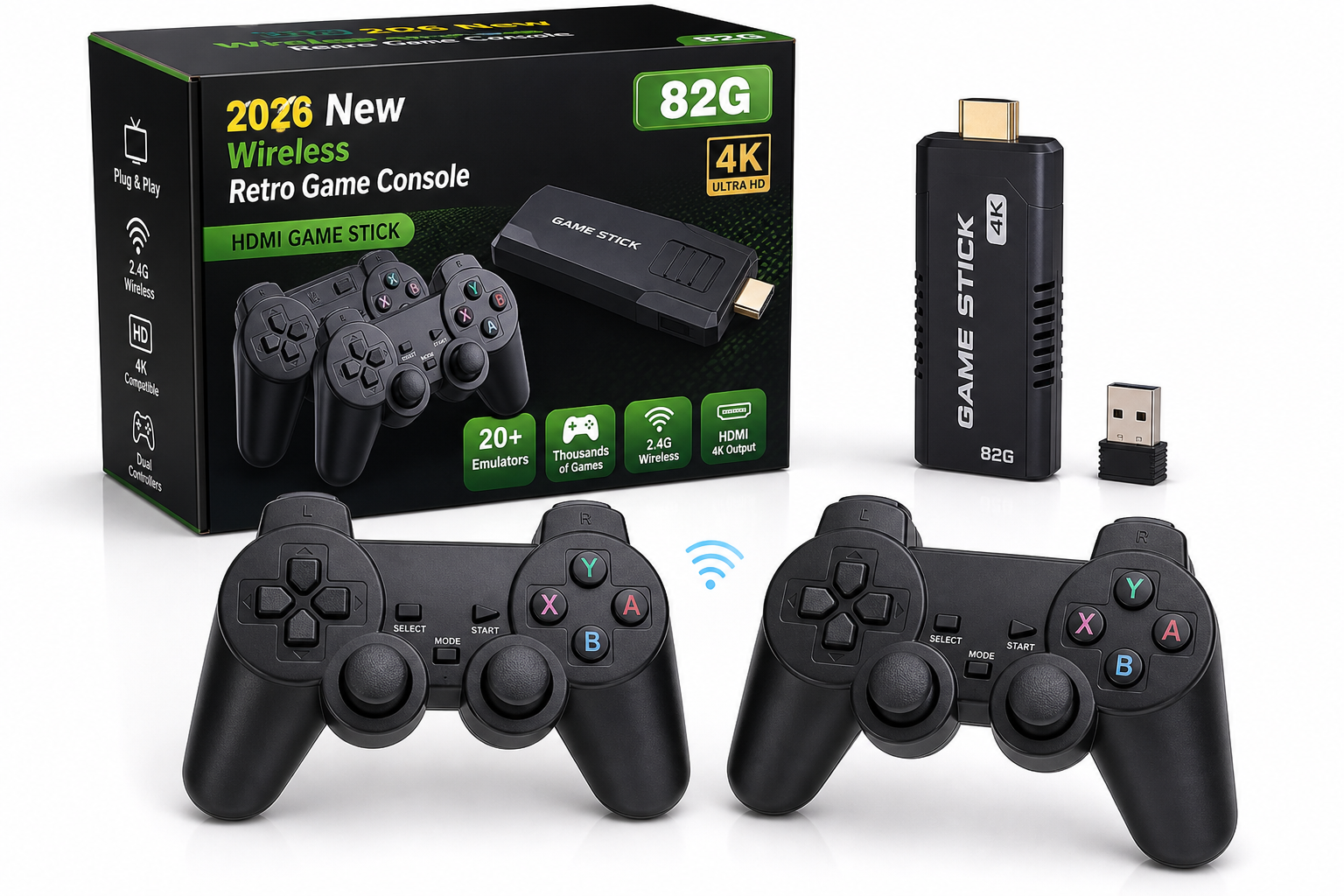
The 2026 New Wireless Retro Game Console (82G) is a plug-and-play TV gaming stick designed for casual retro gaming fans who want a simple, low-cost way to revisit classic titles without complex setup. With built‑in games, support for multiple emulators, 4K HDMI output, and dual 2.4G wireless controllers, it aims to turn any modern TV into a retro arcade in minutes. This review looks at its design, features, performance, strengths, and trade‑offs to help you decide whether it fits your living‑room or party gaming needs.
Introduction
The 2026 New Wireless Retro Game Console (82G) is part of a growing wave of plug‑and‑play TV retro systems. Instead of a full‑size console, you get a compact HDMI game stick and a pair of wireless controllers that promise thousands of built‑in classic titles and a quick setup experience.
Aimed at families, casual players, and anyone looking to relive arcade and console memories on a modern TV, this device focuses on convenience over deep customization. Below, we break down what it offers, how it performs, and who it suits best.
Note: Pricing can fluctuate frequently on marketplaces; for reference, this review will use the placeholder $49.99 instead of a fixed amount.
Product overview and key features
At its core, the 2026 New Wireless Retro Game Console (82G) is an HDMI game stick that plugs directly into your TV or monitor. Power is typically supplied via USB, and the included 2.4G wireless controllers handle all input, so you can game from the couch without running cables across the room.
Design and hardware
- Compact HDMI stick form factor – Small, lightweight, and easy to move between TVs or take to a friend’s house.
- 4K HDMI output (up to 4K compatible) – While the classic games themselves render at much lower resolutions, HDMI output ensures a clean digital signal on modern displays.
- 82G storage configuration – The model is marketed as an 82G variant, indicating a preconfigured internal memory size with a large library of classic titles and emulator files.
- Dual 2.4G wireless controllers – Two gamepads are included for instant multiplayer. These typically use standard AA batteries or built‑in rechargeable cells depending on batch, and connect via low‑latency 2.4 GHz RF.
Software and content
Although individual listings vary, devices in this family commonly share a similar software profile:
- Preloaded multi‑system emulation – The console is usually advertised with a broad set of classic systems (often around 20+ emulators), covering 8‑bit and 16‑bit home consoles, handhelds, and some early 32‑bit platforms.
- Thousands of built‑in games – The library is typically large enough that browsing by category, system, or alphabet is essential.
- Simple, menu‑driven interface – A basic front‑end lets you move between platforms and select games using the controller only—no keyboard or mouse required.
- Save‑state and resume support (varies) – Many such sticks offer quick save/load states for pausing long games, though implementation quality can differ by firmware version.
Setup and connectivity
Getting started is intentionally straightforward:
- Plug the HDMI stick into a free HDMI port on your TV or monitor.
- Connect the power cable (usually included) to a USB port on your TV or a USB power adapter.
- Insert the 2.4G receiver (often built into the stick or provided as a small dongle).
- Switch the TV input to the correct HDMI source.
- Power on and pair controllers if needed; most units arrive pre‑paired.
Within a couple of minutes, you’re in the main menu with a list of systems and games ready to launch.
Performance and user experience
Visual output and compatibility
Classic games are low‑resolution by nature, but the HDMI output ensures they look crisp and stable on modern 1080p or 4K panels. Scaling and aspect handling are basic—expect simple stretching or pillarboxing rather than sophisticated shaders or CRT filters.
The console is generally well‑suited to:
- 8‑bit platforms (NES‑era)
- 16‑bit platforms (SNES/Genesis‑era)
- Early handheld systems
More demanding 32‑bit or 3D titles may be included but can exhibit slowdowns, audio glitches, or longer load times depending on the specific emulator build and hardware inside the stick.
Controller feel and latency
The dual 2.4G wireless controllers are designed to mimic the layout of classic gamepads while retaining modern button counts for multi‑system support:
- Low‑latency 2.4 GHz connection suitable for most retro titles, including action and fighting games.
- Lightweight plastic construction that emphasizes affordability over premium feel.
- D‑pad and face buttons typically tuned for classic platformers and arcade games, though not at the level of name‑brand controllers.
For casual living‑room sessions and party play, the controllers are adequate. More serious retro enthusiasts may still prefer to pair higher‑end controllers through compatible adapters on other platforms, but that’s beyond this stick’s intended use.
Interface and navigation
The user interface prioritizes simplicity:
- A main system selection menu for choosing emulator platforms.
- Game lists under each system, usually sortable by title.
- Basic settings for language, display, audio, and controller options.
Browsing thousands of titles can feel overwhelming, especially when game lists include regional duplicates or fan translations with similar names. However, for casual users, the sheer variety often outweighs the inconvenience.
Stability and reliability
In everyday use, these plug‑and‑play sticks are generally stable once set up correctly:
- Boot times are short.
- Most 2D games run smoothly.
- Occasional crashes or freezes can occur on specific titles or when switching rapidly between emulators; a quick power cycle usually resolves issues.
Because firmware and internal components can vary slightly between production runs, not every unit will behave identically, but the overall experience is consistent with other low‑cost retro TV sticks.
Value proposition
At around $49.99 on Amazon, the 2026 New Wireless Retro Game Console (82G) targets buyers seeking maximum game variety and minimal setup effort rather than cutting‑edge specs or brand‑name polish. Considering the included controllers, HDMI stick, and extensive game library, its value is strongest for households and casual players who want a ready‑to‑use retro solution.
Pros and cons
Pros
- Plug‑and‑play setup: HDMI connection and included wireless controllers make installation simple, even for non‑technical users.
- Large built‑in game library: Thousands of classic titles across many systems mean there is always something new to try.
- Dual 2.4G wireless controllers included: Two players can start gaming immediately without buying extra hardware.
- Compact and portable: Easy to move between rooms, bring to gatherings, or pack for travel.
- 4K‑compatible HDMI output: Works cleanly with modern TVs and monitors.
- Good value for casual use: The bundle of hardware plus content is compelling around the $49.99 mark.
Cons
- Emulation quality varies: 2D titles are generally fine, but more demanding systems may show slowdowns or compatibility quirks.
- Non‑premium build: Plastics and buttons feel functional rather than high‑end.
- Basic interface: Menus are serviceable but lack advanced filters, favorites, or search tools.
- Inconsistent game curation: Large libraries often include duplicates or lower‑interest titles, which can make browsing tedious.
- Limited customization: Compared with full retro handhelds or PC‑based solutions, options for adding your own ROMs or changing cores may be restricted or require technical know‑how.
Conclusion and recommendation
The 2026 New Wireless Retro Game Console (82G) is best understood as a simple, fun, and low‑maintenance way to bring retro gaming to the living room. It won’t replace more powerful emulation boxes or enthusiast‑grade handhelds for purists, but it excels in situations where ease of use and quick multiplayer sessions matter more than perfect accuracy or deep configuration.
You should consider this console if:
- You want an affordable, all‑in‑one retro solution around $49.99 that works on any HDMI TV.
- You prioritize instant access to a large variety of classic games over hand‑picked, perfectly curated libraries.
- You need a family‑ or party‑friendly device that anyone can operate with minimal instructions.
On the other hand, if you care deeply about cycle‑accurate emulation, premium build quality, or extensive customization, you may be better served by a more advanced (and typically more expensive) retro gaming platform.
For its intended audience—casual players and nostalgia seekers—the 2026 New Wireless Retro Game Console (82G) delivers a straightforward, entertaining way to revisit classic games on a modern TV with minimal hassle.