
Meta Quest 3 512GB Gorilla Tag Monkenaut Bundle Review: Big Storage, Mixed Reality, and a Ready-Made Game Library
The Meta Quest 3 512GB Gorilla Tag Cardboard Monkenaut Bundle is an Amazon-exclusive package that combines Meta’s high-end standalone VR hardware with a themed Gorilla Tag accessory and a 3‑month trial of Meta Horizon+, granting access to a large catalog of games and experiences. With ample 512GB storage, dual controllers, inside‑out tracking, and mixed reality support, it targets users who want a wire-free, console‑free entry into VR gaming, fitness, and entertainment. This review looks at setup, daily use, performance, strengths, and trade-offs to help you decide if this large-capacity Quest 3 bundle is the right choice.
Introduction
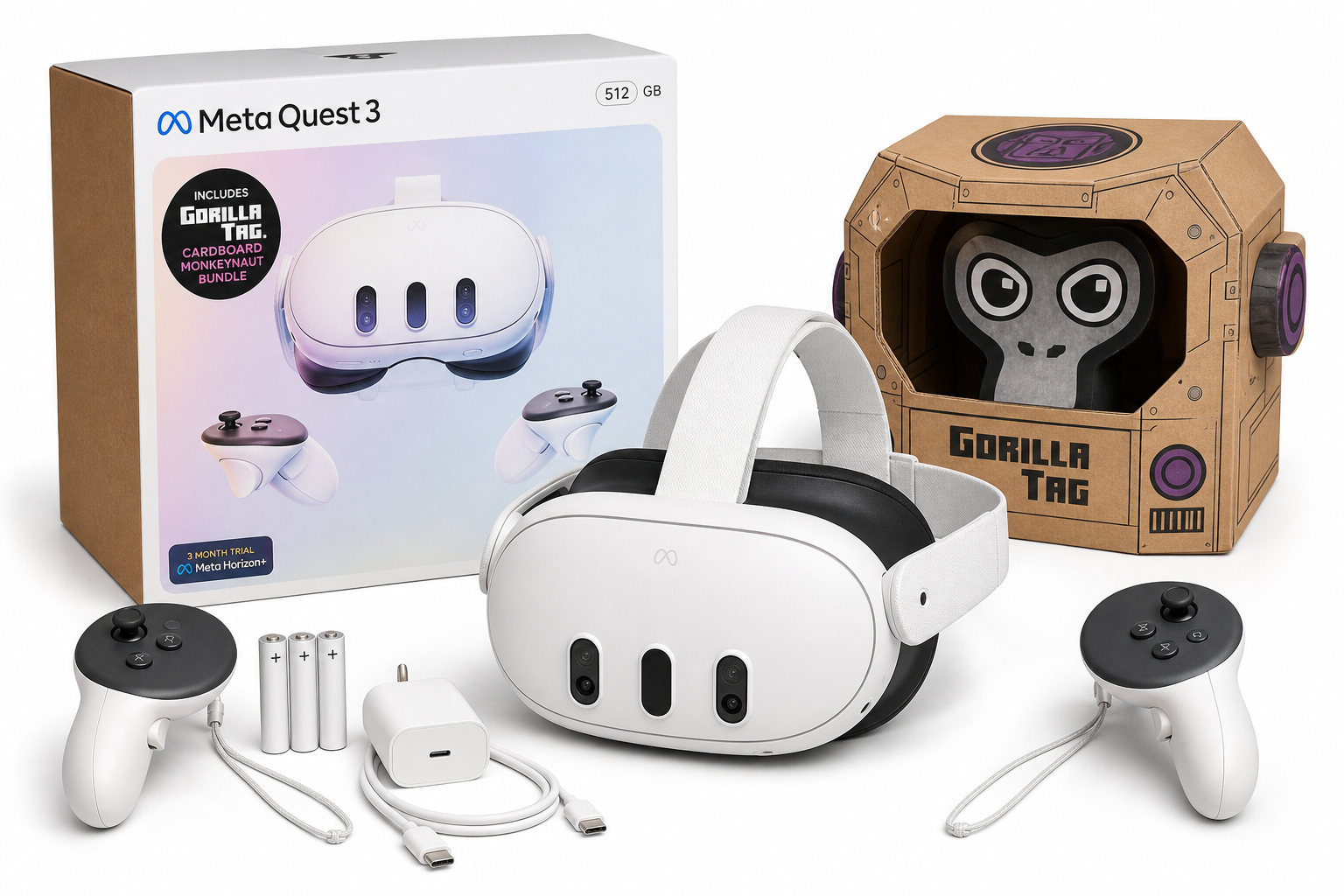
The Meta Quest 3 512GB | VR Without Wires — Gorilla Tag Cardboard Monkenaut Bundle — Amazon Exclusive is designed for buyers who want Meta’s current-generation standalone VR headset with maximum on-device storage and some added value out of the box. The bundle includes:
- Meta Quest 3 headset with 512GB of internal storage
- Two Meta Quest Touch Plus controllers
- Gorilla Tag Cardboard Monkenaut accessory set
- Charging cable and power adapter
- A 3‑month trial of Meta Horizon+, which unlocks access to 100+ games and apps during the trial period
Unlike PC-tethered headsets, the Quest 3 runs games natively, with optional PC VR streaming over Wi‑Fi. In practice, that means you can unbox it, charge it, sign in with a Meta account, and start playing without any console, gaming PC, or external trackers.
From a value standpoint, the Amazon listing for this bundle typically sits around $599.00, which positions it as a premium standalone VR option. The added storage, bundled Gorilla Tag content, and subscription trial are intended to offset that higher price tag.
Setup / Getting Started
Unboxing and physical setup
Inside the box you’ll find the headset with facial interface pre-installed, two controllers with wrist straps, AA batteries for the controllers, and the USB‑C charging cable with power adapter. The Gorilla Tag Cardboard Monkenaut accessory is a themed add-on that ties into the popular Gorilla Tag experience; it’s essentially a cosmetic and packaging twist rather than a functional hardware change.
Physical setup is straightforward:
- Fit the headset: Adjust the soft strap and rear tension to sit comfortably on the crown of your head. The Quest 3 is lighter and better balanced than many PC VR headsets, but some users may still prefer an aftermarket strap for long sessions.
- Insert controller batteries: Each Touch Plus controller takes one AA battery. Once inserted, they power on automatically when moved.
- Charge the headset: Plug the USB‑C cable into the headset and wall adapter. A full initial charge is recommended before the first long play session.
- Power on: Press and hold the power button to boot into the setup experience.
Software onboarding
Initial software setup involves a few key steps:
- Wi‑Fi connection: Connect the headset to your home network so it can sign in, download updates, and access the Meta store.
- Meta account login: You’ll need a Meta account; once signed in, your purchases and profile sync to the device.
- Guardian/boundary setup: Using the passthrough view, you trace your safe play area. This is critical if you plan to move around actively, especially for games like Gorilla Tag.
- Meta Horizon+ trial activation: The bundle includes a 3‑month trial, which you’ll activate through your Meta account. After activation, eligible games in the Horizon+ catalog become available to install and play during the trial period.
The entire process usually takes 15–30 minutes, depending on your Wi‑Fi speed and the number of updates.
Daily Usage
Comfort and ergonomics
In day-to-day use, the Quest 3 512GB feels similar to the standard Quest 3 variants: relatively compact with an improved facial interface and more balanced weight compared with earlier standalone VR headsets. For shorter sessions (30–60 minutes), the default soft strap is generally adequate. Extended multi-hour sessions may cause some forehead or cheek pressure, particularly for users with smaller or larger-than-average head sizes.
The controllers are light, with precise tracking and a familiar button layout if you’ve used other Meta headsets. Wrist straps help prevent accidental drops during active games.
Storage and content management
The standout difference of this model is its 512GB of internal storage. In practice, that translates to:
- Enough room for dozens of large VR games, fitness apps, and media experiences simultaneously
- Less frequent need to uninstall and reinstall large titles
- A more “console-like” feel, where the library is always available without constant storage juggling
For players who plan to take advantage of the Horizon+ catalog, the extra capacity is valuable. You can install a broad mix of genres—action, fitness, simulation, casual party titles—without constantly checking remaining space.
Gorilla Tag and casual play
The Gorilla Tag Cardboard Monkenaut branding is aimed squarely at fans of Gorilla Tag, a highly active, movement-first VR game where you move by swinging your arms. While the cardboard Monkenaut is not a hardware upgrade, it contributes to the themed experience and is likely to appeal to younger or more casual players excited by the specific game tie-in.
In daily use, Gorilla Tag and similar titles demonstrate one of the Quest 3’s best traits: room‑scale, wire-free movement. With the Guardian system properly set up, you can run, duck, and reach without being anchored by cables.
Media, productivity, and mixed reality
Beyond gaming, the Quest 3 works well for streaming video, watching movies on virtual big screens, and light productivity apps like virtual desktops or remote PC access. The color passthrough cameras enable mixed reality experiences—overlaying virtual objects on your real environment—so you can, for example, play tabletop games on your actual desk or use MR fitness apps that make your living room part of the scene.
Performance & Reliability
Visuals and tracking
The Meta Quest 3 features high-resolution displays (over 4K combined) and supports refresh rates up to 120Hz in compatible content. In practice, this means:
- Sharper text and UI elements than older standalone headsets
- Reduced screen-door effect and more detailed game visuals
- Smooth motion in many titles, provided developers have optimized for the device
Inside‑out tracking, using cameras on the headset, reliably follows both head and controller movements in most lighting conditions. For highly active games like Gorilla Tag or Beat Saber, tracking remains stable enough to avoid the disorienting glitches that plagued earlier generations.
Processing and wireless freedom
The underlying chipset provides a noticeable performance bump over prior standalone Meta headsets, enabling richer graphics and more complex environments without a tether. Heavy titles will still run at reduced settings compared with high-end PC VR, but for most users the balance between fidelity and convenience is strong.
If you do own a capable gaming PC, you can stream PC VR titles over Wi‑Fi using Meta’s built-in solution or third-party apps. This effectively lets the Quest 3 behave like a wireless PC VR headset when needed, though performance and clarity depend on your network quality.
Battery life and charging
Typical battery life hovers around 2 to 2.5 hours of active use on a full charge, varying based on brightness, refresh rate, and app intensity. For casual sessions or shorter workouts, this is usually adequate; marathon gaming sessions may require breaks for charging or use of an external battery pack.
The included USB‑C charger replenishes the battery in a couple of hours. There’s no dock in the box, so users who want a more convenient charging solution may opt for a third-party stand or charging dock.
Reliability and software updates
Meta’s software platform is mature, with frequent updates that add features, improve tracking, and fix bugs. Over time, these updates can enhance the experience, though they may occasionally change UI layouts or introduce minor regressions that are later patched.
In everyday use, the combination of stable tracking, responsive UI, and a large app catalog makes the Quest 3 a dependable primary VR device for most households.
What Works Well
-
Generous 512GB storage
The key selling point is ample storage. It lets you maintain a large library of games, fitness apps, and mixed reality experiences simultaneously, which is especially helpful if multiple people use the headset. -
True standalone, wire-free VR
No PC or console is required. Everything runs directly on the headset, which reduces friction and makes it much more likely you’ll use it regularly. -
Meta Horizon+ 3‑month trial
Access to 100+ games and apps during the trial makes it easy to explore a wide range of titles without committing additional spending immediately. It’s a strong way to discover favorites before deciding what to buy outright. -
Mixed reality capabilities
Color passthrough and MR support expand the possibilities beyond pure VR. This is particularly appealing for living-room experiences, family-friendly games, and applications that integrate with your real environment. -
Amazon-exclusive Gorilla Tag bundle
For Gorilla Tag fans, the Cardboard Monkenaut bundle is a fun, themed way to enter VR. It signals clearly that the headset is well-suited for active, social VR games. -
Solid overall performance
Visual clarity, refresh rate support, and tracking quality make the Quest 3 a comfortable platform for both novice and experienced VR users, whether they’re playing rhythm games, narrative adventures, or fitness apps.
What Could Be Improved
-
Price vs. lower-capacity models
While the larger storage is convenient, the bundle’s pricing around $599.00 will feel steep to users who are comfortable managing a smaller library on a 128GB model. If you’re not planning to install many large games at once, you may not fully utilize the extra capacity. -
Default strap comfort for long sessions
The stock soft strap is serviceable but not ideal for extended use. Many users will eventually invest in an upgraded strap for better weight distribution and long-term comfort. -
Battery life limitations
A roughly 2–2.5 hour play window per charge means frequent users either accept regular charging breaks or purchase an external battery accessory. Built-in longer battery life would better match the storage and performance ambitions. -
Gorilla Tag bundle is mostly thematic
The Cardboard Monkenaut element is more about branding and presentation than adding new hardware capabilities. It’s enjoyable for fans, but those uninterested in Gorilla Tag may not see it as a meaningful value add. -
Subscription decision after the Horizon+ trial
The 3‑month Meta Horizon+ trial is a generous way to sample content, but it also introduces a decision point once the trial ends. Users who dislike ongoing subscriptions may prefer to purchase individual titles instead.
Overall Impression
The Meta Quest 3 512GB Gorilla Tag Cardboard Monkenaut Bundle is a compelling option for buyers who:
- Want a high-capacity, standalone VR headset that can store a large, varied library
- Are interested in active, social VR games like Gorilla Tag
- Plan to explore many different titles via the 3‑month Meta Horizon+ trial
- Prefer the simplicity of wire-free, console-free VR, with the option to stream PC VR when desired
Its main trade-offs are cost and the typical limitations of standalone VR: moderate battery life, a default strap that may not suit marathon sessions, and performance that, while strong, still falls short of high-end PC VR for the most demanding users.
If you envision the headset as a shared household device, want to avoid constant storage management, and like the idea of diving into a large pool of games and experiences right away, this Amazon-exclusive 512GB bundle is well-aligned with those priorities. For budget-conscious buyers who don’t need as much storage, a smaller-capacity Quest 3 may offer better value; but for those who value convenience, catalog breadth, and room to grow, this bundle makes a strong case as a long-term VR investment at around $599.00.