
Beelink SER9 Mini PC Review: Compact Powerhouse with AMD Ryzen 7 H255
The Beelink SER9 Mini PC is a compact desktop computer built around AMD’s Ryzen 7 H255 processor and Radeon 780M integrated graphics, paired with LPDDR5X memory and a PCIe 4.0 SSD. It targets users who want desktop-class performance in a very small footprint for productivity, light to moderate gaming, media consumption, and home or office use. This review looks at its design, performance, thermals, connectivity, and day‑to‑day experience, while outlining strengths, weaknesses, and the types of workloads and users it suits best.
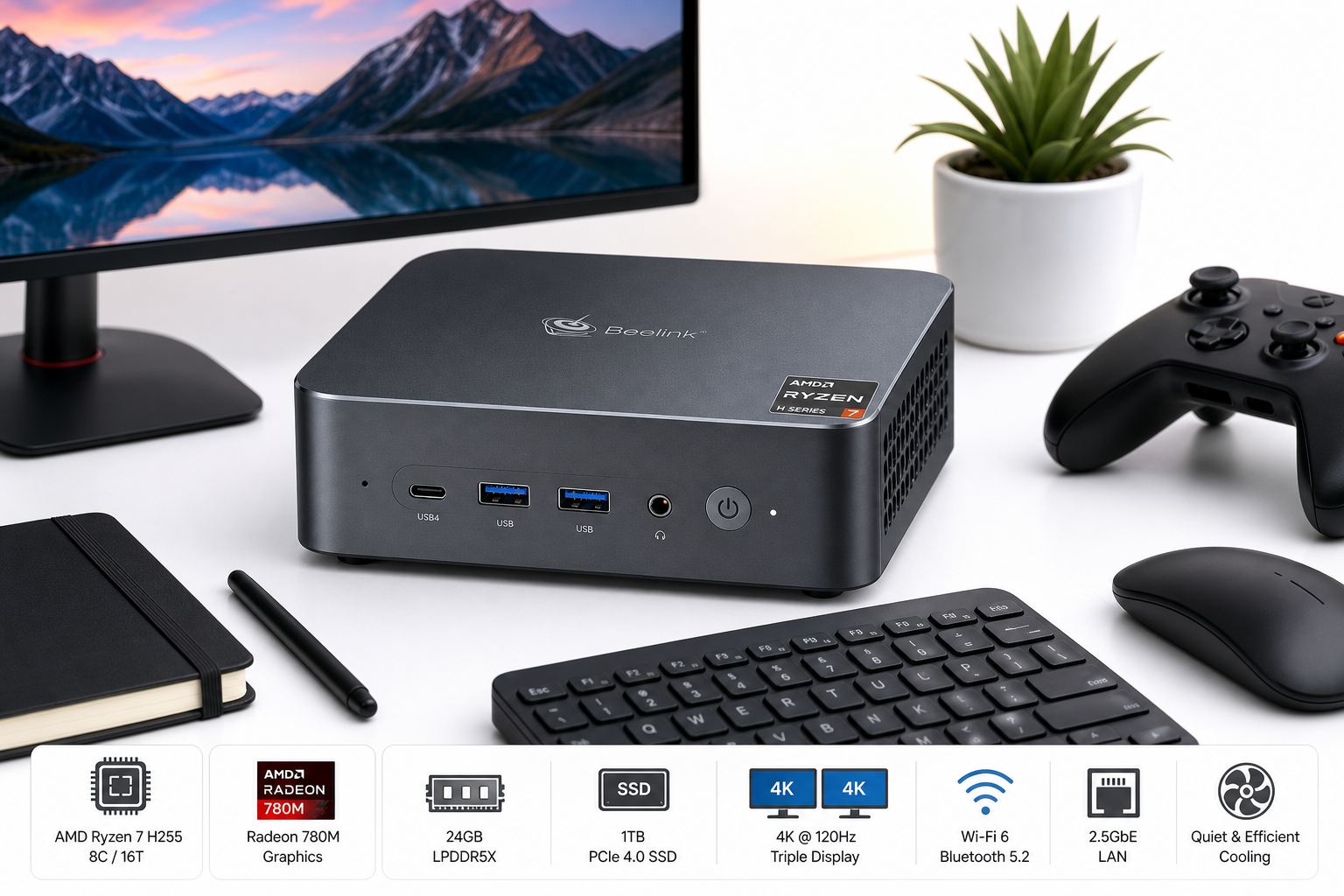
Overview
The Beelink SER9 Mini PC is a small‑form‑factor desktop designed to deliver strong multi‑threaded performance and capable integrated graphics in a chassis that fits easily on a desk, behind a monitor, or in a media center. It combines an AMD Ryzen 7 H255 (8 cores / 16 threads) processor with LPDDR5X memory and a PCIe 4.0 NVMe SSD, aiming to bridge the gap between ultra‑compact office boxes and full‑size gaming towers.
This particular configuration (as listed on Amazon under the product name “Beelink SER9 Mini PC, AMD Ryzen 7 H255 8C/16T, 24G LPDDR5X 1TB PCIe4.0 SSD | Mini Desktop Computer, Small Gaming PC Support 4K@120Hz Output/BT5.2/WiFi 6 for Gaming/Office/Home”) is positioned as an all‑rounder for office tasks, coding, light to mid‑range gaming, and 4K media playback.
If the budget allows (currently around $699.00 on Amazon), it can be an attractive option for users who value compactness and low power consumption but still want responsive performance and modern connectivity.
Key Highlights
- CPU: AMD Ryzen 7 H255, 8 cores / 16 threads (Zen 4 architecture), boost up to around 4.9 GHz (vendor‑quoted)
- Memory: 24 GB LPDDR5X (soldered, high bandwidth, non‑upgradeable)
- Storage: 1 TB NVMe PCIe 4.0 SSD (upgradeable via M.2 slot)
- Graphics: Integrated AMD Radeon 780M iGPU
- Display support: Up to 4K @ 120 Hz output (via HDMI/DisplayPort/USB4, depending on port configuration)
- Connectivity: Wi‑Fi 6, Bluetooth 5.2, 2.5 GbE LAN (typical for this platform), multiple USB‑A and USB‑C ports
- Form factor: Very compact mini PC suitable for VESA mounting or small desks
- Target use: Productivity, web, media, development, emulation, and light to moderate gaming
Core Features
Processor and Platform
At the heart of the Beelink SER9 is AMD’s Ryzen 7 H255, a mobile‑class CPU with 8 cores and 16 threads based on a modern Zen architecture. This chip is designed for thin laptops and small desktops, offering a balance of strong multi‑core performance and relatively modest power draw.
In practical terms, this CPU is well‑suited for:
- Multitasking with many browser tabs and productivity apps
- Office workloads (Office suite, videoconferencing, remote work tools)
- Software development and light local data workloads
- Photo and light video editing
It is not on the same level as high‑end desktop CPUs in sustained, long‑duration rendering or heavy workstation loads, but it is a notable step up from low‑power Celeron/Pentium and older U‑series chips.
Memory Subsystem
This configuration uses 24 GB of LPDDR5X memory, soldered to the board. LPDDR5X offers:
- High bandwidth, improving integrated GPU performance
- Lower power consumption compared to standard DDR4
The trade‑off is that RAM is not user‑upgradeable. For most office, productivity, and moderate creative use, 24 GB is sufficient; power users who routinely work with very large datasets or heavy virtual machine stacks may hit the ceiling sooner.
Storage
Beelink equips the SER9 with a 1 TB PCIe 4.0 NVMe SSD, offering fast boot times and snappy application loading. Typical characteristics:
- Sequential read/write speeds much higher than SATA SSDs
- Enough capacity for Windows, applications, and a moderate local game or media library
In many SER9 variants, the M.2 slot is user‑accessible, allowing replacement with a higher‑capacity drive if needed. Check Beelink’s documentation or the specific Amazon listing to confirm if there is a second M.2 slot; configurations vary slightly by market.
Graphics: Radeon 780M
The integrated AMD Radeon 780M GPU is a high‑end iGPU for this class. It offers:
- Comfortable performance for everyday UI, 4K video playback, and streaming
- Playable frame rates in many eSports and lighter titles at 1080p with tuned settings
- The ability to run some more demanding games at reduced resolution and quality
It is still an integrated solution, so expectations should be calibrated below discrete GPUs like Radeon RX 7600 or GeForce RTX 4060, especially for AAA titles.
Display and Ports
The SER9 supports up to 4K @ 120 Hz output (depending on the connected display and port) and typically offers multiple display outputs (such as HDMI 2.1, DisplayPort 1.4, and a USB‑C/USB4 port on many configurations). This allows
- Dual‑ or triple‑monitor office setups
- High‑refresh 4K or 1440p monitors for smoother desktop and gaming experience
Exact port layout can vary between batches, but you can generally expect:
- HDMI and/or DisplayPort outputs
- At least one USB‑C port (often capable of video output)
- Several USB‑A ports for peripherals
- 2.5 GbE Ethernet port
- 3.5 mm audio jack
Connectivity
The SER9 supports Wi‑Fi 6 and Bluetooth 5.2, providing modern wireless performance and compatibility with recent routers, headphones, controllers, and other Bluetooth devices. Wired networking over 2.5G Ethernet (where available) is a notable plus for users who transfer large files or rely on low‑latency connections.
Usage Experience
Everyday Productivity
In day‑to‑day desktop use, the Beelink SER9 feels markedly faster than older dual‑core or low‑power mini PCs. Windows boots quickly, applications launch without delay, and multitasking across office apps, browser tabs, and communication tools remains smooth.
For remote work setups, the combination of strong CPU performance, multiple monitor support, and quiet operation makes it a capable primary machine, provided you are not running heavy 3D or workstation‑grade tasks.
Media and Home Theater Use
With its compact chassis and low power draw, the SER9 fits well under a TV or in a media cabinet. The Radeon 780M iGPU and modern video decode hardware handle:
- 4K HDR streaming from major services
- Local 4K video playback
- Multi‑channel audio output through HDMI
The ability to drive 4K @ 120 Hz (with a compatible TV or monitor) also benefits users who want a very responsive UI or high‑refresh media playback.
Gaming and Emulation
While marketed as a “small gaming PC”, it is best to think of the SER9 as a capable 1080p eSports and casual gaming machine, not a replacement for a dedicated gaming tower with a mid‑range GPU.
You can expect:
- Smooth performance in lighter or older titles (MOBA, FPS, racing, indie games) at 1080p with medium‑to‑high settings
- Playable performance in some modern AAA games with settings turned down and/or resolution scaled below 1080p
- Strong performance in many emulators (retro systems, PS2, and other earlier consoles), with more demanding emulators depending heavily on per‑title optimization
If your workload is dominated by new AAA games at high details or 1440p/4K, you will hit the limits of the integrated GPU.
Thermals and Acoustics
As with many powerful mini PCs, thermals and fan noise depend heavily on ambient temperature, TDP configuration, and workload. Under light or moderate loads, the SER9 generally remains quiet, with fans ramping up primarily during sustained CPU+GPU stress (e.g., gaming, rendering, or benchmarks).
Some users may prefer to tweak power limits in BIOS or use software tools to balance noise and performance. Out of the box, it is typically tuned to favor performance, which can mean audible but not overwhelming fan noise when pushed hard.
Upgradability and Maintenance
Key considerations on this configuration:
- RAM is not upgradeable (soldered LPDDR5X)
- Storage is upgradable via the M.2 slot, and in some variants you may get an additional slot for a second NVMe drive
- Accessing internals usually involves removing the bottom panel, which is manageable for most technically inclined users
This makes the SER9 better suited to buyers who are satisfied with 24 GB RAM and mainly want storage flexibility.
Strengths
- Strong CPU performance for the size: 8C/16T Ryzen 7 H255 handles multitasking, coding, compilation, and light content creation well.
- Capable integrated graphics: Radeon 780M enables light to moderate gaming and smooth 4K media playback in a fanless‑GPU footprint.
- Modern memory and storage: LPDDR5X RAM and PCIe 4.0 SSD deliver fast real‑world responsiveness.
- Compact and versatile form factor: Easy to place on a crowded desk, VESA‑mount behind a monitor, or integrate into a TV setup.
- Good connectivity: Wi‑Fi 6, Bluetooth 5.2, 2.5 GbE (model‑dependent), and multiple display outputs cover most home and office needs.
- Low power consumption compared to full desktops: Makes sense for always‑on use or power‑constrained environments.
Weaknesses
- Non‑upgradeable RAM: The 24 GB ceiling cannot be raised later; heavy workstation or virtualization users may find this limiting.
- Integrated GPU limitations: Despite being one of the better iGPUs, Radeon 780M can’t match dedicated mid‑range GPUs for high‑end gaming.
- Thermal headroom is finite: In sustained combined CPU+GPU loads, performance is bound by the small cooling system and chassis volume.
- Price can be high for some segments: Depending on current discounts, the SER9 may overlap with entry‑level discrete‑GPU desktops, especially when priced around $699.00.
- Port and feature variations: Slightly different configurations across regions can make it important to double‑check the exact listing for ports and included features.
Suitable Scenarios
The Beelink SER9 is especially well‑suited for:
-
Home and office productivity PCs
- Email, documents, spreadsheets, web apps
- Dual‑monitor productivity setups
- Remote‑work stations where desk space and power use matter
-
Developer and technical workstations (light to moderate)
- IDEs, compilers, local test servers
- Docker containers and databases with moderate resource needs
- Data analysis workflows that fit comfortably within 24 GB RAM
-
Media and entertainment hubs
- 4K streaming and local media playback
- HTPC setups with high‑refresh monitors or TVs
-
Casual and eSports gaming machines
- Popular competitive titles at 1080p with tuned settings
- Retro and mid‑generation console emulation
-
Compact office deployments
- Reception, call centers, classrooms, or kiosks where space and cable management are priorities
It is less ideal if your primary workload is:
- High‑end AAA gaming at 1440p/4K and ultra settings
- Heavy 3D rendering, large‑scale simulations, or workstation‑class video production
- Virtualization farms or multiple high‑memory VMs that need well beyond 24 GB RAM
Final Evaluation
The Beelink SER9 Mini PC with AMD Ryzen 7 H255, 24 GB LPDDR5X RAM, and 1 TB PCIe 4.0 SSD occupies an appealing middle ground between ultralight office mini PCs and bulky gaming towers. It delivers strong CPU performance, competent integrated graphics, fast storage, and modern connectivity in a very compact chassis.
Its main compromises—non‑upgradeable RAM, integrated‑only graphics, and thermals bounded by a small cooling system—are typical for this category. For users whose workloads fit within those constraints, the SER9 is a capable, space‑saving machine that can comfortably serve as a daily driver PC, media hub, or compact gaming system for lighter titles.
If you are comfortable with the price point (around $699.00 on Amazon at the time of writing) and your usage pattern aligns with its strengths—productivity, development, media, and moderate gaming—the Beelink SER9 is a well‑rounded mini PC that merits serious consideration.