
GameSir G7 Pro 8K PC Wireless Controller (Nioh 3 Edition) Review: Esports-Focused Precision for PC Players
The GameSir G7 Pro 8K PC Wireless Controller Nioh 3 Edition is a PC-focused esports gamepad that combines ultra-high polling rates with magnetic-resistance TMR joysticks, Hall Effect analog triggers, and micro switch face buttons. Designed specifically for Windows PC users, it offers wired USB-C and 2.4 GHz wireless modes, four remappable macro buttons, motion control, and a 3.5 mm audio jack that works in both wired and wireless modes. This review examines its design, features, performance in fast-paced games, and trade-offs such as platform limitations and some reported quality-control concerns.
Introduction
The GameSir G7 Pro 8K PC Wireless Controller, Nioh 3 Edition, targets a very specific audience: PC players who care about low input latency, precise aiming, and long-term stick reliability more than broad platform compatibility. It takes the well-regarded G7 Pro formula and pushes it further with an 8000 Hz polling rate on PC, next‑generation TMR (magnetic‑resistance) sticks, Hall Effect analog triggers, and a set of remappable macro buttons.
Unlike GameSir’s Xbox-licensed G7 Pro variants, this Nioh 3 Edition is built first and foremost for PC play. If you primarily game on Windows and want an esports‑leaning pad that still feels comfortable for general use, it’s a strong contender in its class.
It usually sits around $89.99 on Amazon, positioning it above budget controllers but below some flagship premium pads.
Key Points
- Platform focus: Designed for Windows PC, with USB‑C wired and 2.4 GHz wireless connectivity.
- 8K polling rate (PC only): Up to 8000 Hz polling over both wired and 2.4 GHz on PC, significantly reducing input latency compared with standard 1000 Hz pads.
- TMR joysticks: Gen‑2 GameSir Mag‑Res TMR sticks are designed to be smooth and resistant to traditional mechanical wear, helping to mitigate stick drift over time.
- Hall Effect analog triggers: Magnetic Hall sensors for the triggers reduce wear and provide consistent analog response; paired with micro switch trigger stops for a shorter throw when desired.
- Micro switch face buttons and D‑pad: Optical micro switches for ABXY and mechanical micro switches for the D‑pad aim for crisp, fast, and consistent inputs.
- Macro and extra buttons: Four remappable macro buttons (two rear paddles and two additional bumpers) help offload key actions for competitive play.
- 3.5 mm audio support: Headset audio works in both wired and 2.4 GHz wireless modes, making it convenient for PC setups.
- Customisation software: GameSir Connect software on PC allows adjustments such as polling rate, dead zones, macros, and other tuning.
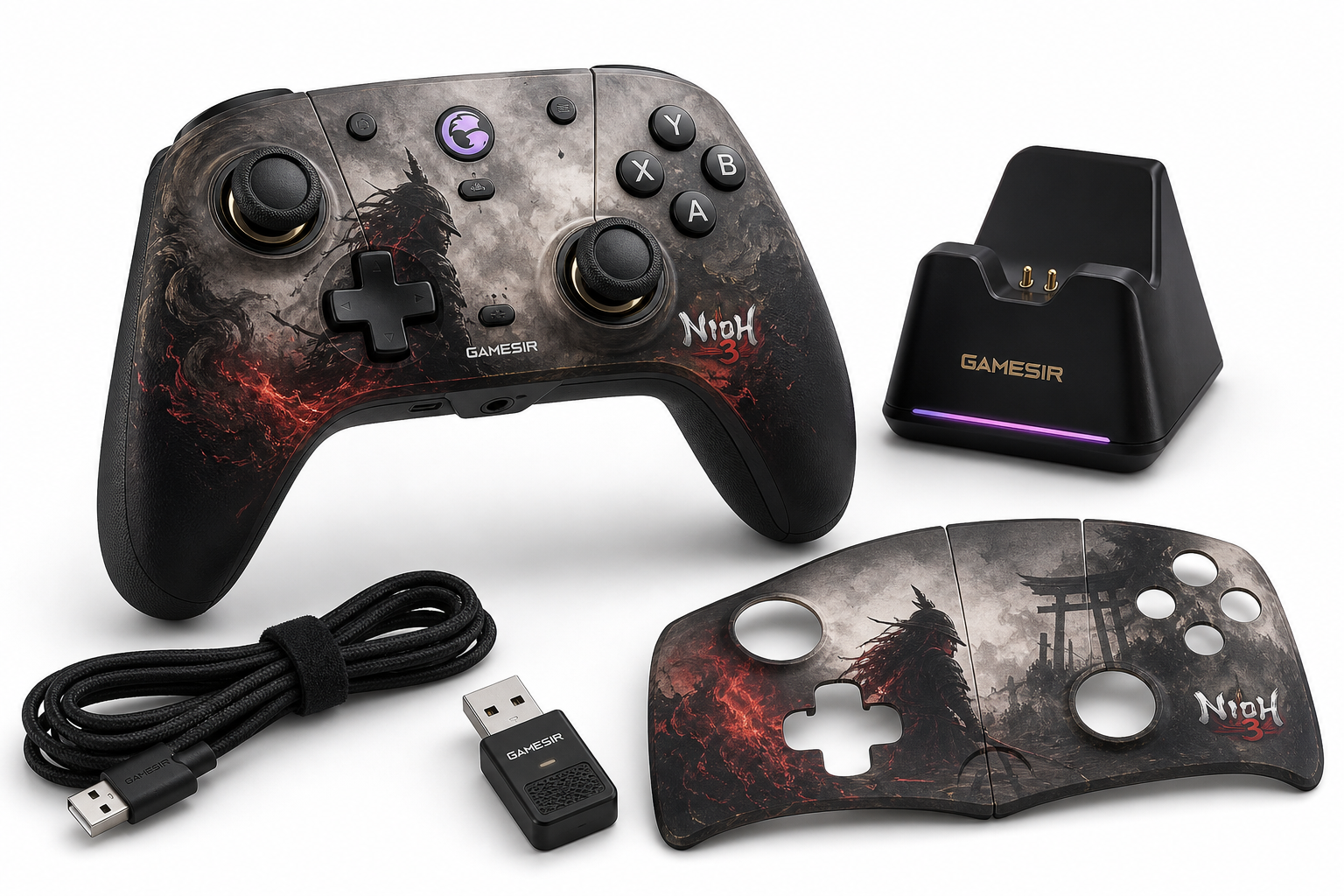
- Nioh 3‑themed design: Special Nioh 3 Edition artwork and finish on a three‑piece magnetic, swappable faceplate.
Experience
Design and Build
In the hand, the GameSir G7 Pro 8K Nioh 3 Edition follows a familiar Xbox-style silhouette with ergonomically shaped grips and a conventional stick-and-button layout. The plastic shell feels solid, and the weight is moderate for a wireless controller (with a built‑in 1200 mAh battery and included charging dock in some bundles). The Nioh 3 styling gives it a distinct look, with artwork printed on a three-piece magnetic faceplate.
The faceplate can be removed and swapped, which not only aids cleaning and customisation but also makes it easier to access the sticks if you’re into light modding. Some users have noted that certain Nioh 3 plates can have slightly off‑center or softer printing compared with the standard designs, but functionally this doesn’t impact performance.
The grips are contoured for long sessions, though the overall profile leans a bit more toward a traditional Xbox-style controller than super-slim competitive pads. For most hand sizes it should feel natural; if you already like Xbox‑shaped controllers, the transition will be easy.
Sticks, Triggers, and Buttons
The standout hardware features on this controller are the Gen‑2 Mag‑Res TMR joysticks and Hall Effect analog triggers. Together, they address two of the biggest long‑term pain points with controllers: stick drift and trigger wear.
- TMR sticks use a magnetic‑resistance sensing method rather than traditional potentiometers, reducing the physical contact points that typically wear down and cause drift. In use, they feel smooth and stable, with precise response suitable for FPS, action, and fighting games.
- Hall Effect triggers rely on magnetic sensors, so there’s no physical potentiometer track to degrade. The trigger pull is linear and consistent, and the included micro switch trigger stop mechanism lets you shorten the effective travel for faster fire in shooters if you don’t need full analog range.
The ABXY buttons use optical micro switches, giving them a short actuation distance and fast, crisp feel. They are more “clicky” than rubber‑dome buttons but not excessively loud once game audio is playing. The D‑pad uses mechanical micro switches, offering clear directional feedback that works well for platformers, fighting games, and menu navigation.
Polling Rate and Latency
A key selling point of the G7 Pro 8K Nioh 3 Edition is its 8000 Hz polling rate on PC in both wired and 2.4 GHz wireless modes when configured appropriately. This is far above the standard 125–1000 Hz range of typical controllers.
In practice, most players will experience this as extremely responsive inputs with minimal latency. The difference from 1000 Hz can be subtle in many games, but in high‑level FPS or action titles where reaction times matter, the lower input delay becomes more noticeable, especially on high refresh rate monitors.
It’s worth noting that you need:
- A PC capable of handling the higher polling; and
- Games or environments where extremely low latency yields a practical benefit.
Casual players may not see a dramatic improvement over a well‑tuned 1000 Hz controller, but those sensitive to latency or coming from older pads often describe immediate responsiveness gains.
Connectivity and Compatibility
This Nioh 3 Edition is a PC‑centric controller. It supports:
- USB‑C wired connection to Windows PCs.
- 2.4 GHz wireless via the included dongle.
Its main use case is Windows, and it presents itself as a standard XInput or related controller mode depending on configuration. Some users on Linux and other non‑Windows platforms have reported that additional setup or manual mode switching is needed, and some advanced features like macros or polling adjustments require the GameSir Connect software on Windows.
Unlike some G7 Pro variants, this edition does not target Xbox console support, so if console compatibility is a priority, this may not be the best match.
Software and Customisation
Using the GameSir Connect software on PC, you can:
- Adjust polling rate (including enabling 8K where supported).
- Configure dead zones for the TMR sticks.
- Tweak trigger sensitivity.
- Map the four macro buttons (back paddles and extra bumpers) to other controller inputs.
- Set up turbo and other advanced profiles.
The macro implementation on this model focuses on mapping to single button presses rather than complex multi‑input sequences. This suits many competitive scenarios where you just want common actions (jump, dodge, sprint, reload) relocated to paddles, but it’s less flexible if you rely on macros that combine multiple buttons in one press.
Overall, the software offers a good balance of depth and usability, but you will need a Windows machine to get full value from the controller’s customisation capabilities.
Comfort and Long‑Session Use
Ergonomically, the G7 Pro 8K Nioh 3 Edition sits in a familiar zone. The grips are rounded, and the weight distribution feels even, though the inclusion of a battery and rumble motors makes it heavier than ultra‑light wired‑only pads.
The back paddles and extra bumpers are placed where most players can reach them without drastically shifting grip. However, depending on hand size and play style, some people may find they accidentally brush the extra bumpers when using the primary shoulders. This is something you may need to adapt to, or you can leave some of the additional buttons unassigned if they prove intrusive.
The micro switch buttons, while generally praised for their responsiveness, do have a more tactile “click” that not everyone prefers. If you like the soft, muted feel of traditional membrane buttons, this will feel different—but the benefit is faster, more consistent actuation for competitive play.
Battery life is typical of wireless esports‑leaning controllers with strong rumble and high polling rates: it’s adequate for extended sessions, but you’ll still want to charge periodically or use it wired when convenient.
Pros
- Extremely low latency on PC with up to 8000 Hz polling in both wired and 2.4 GHz wireless modes.
- Gen‑2 TMR magnetic joysticks designed to reduce conventional stick wear and mitigate drift.
- Hall Effect analog triggers with micro switch trigger stops for fast, precise trigger response.
- Optical and mechanical micro switches on face buttons and D‑pad for crisp, fast actuation.
- Four remappable macro buttons (two rear paddles and two extra bumpers) to offload common actions.
- 3.5 mm audio jack works in both wired and 2.4 GHz wireless modes on PC, simplifying headset use.
- Magnetic, swappable three‑piece faceplate for easier cleaning and cosmetic customisation.
- Solid overall build and comfortable Xbox‑style ergonomics for most hand sizes.
- Deep PC customisation via GameSir Connect software (polling rate, dead zones, macros, and more).
- Themed Nioh 3 design for fans of the series.
Cons
- PC‑focused design means limited or no native support for some consoles; not ideal if you want a single pad for multiple platforms.
- Macro buttons limited to single‑button mappings, which may not satisfy players relying on more complex macro sequences.
- Micro switch face buttons are clicky, which some users may find noisy or less comfortable than rubber‑dome switches.
- Extra shoulder buttons can be easy to press accidentally for some grip styles.
- Niche benefits of 8K polling: casual players may not notice a large difference versus good 1000 Hz controllers.
- Reports from some users of inconsistent cosmetic printing on certain Nioh 3 faceplates.
Verdict
The GameSir G7 Pro 8K PC Wireless Controller Nioh 3 Edition is a focused, esports‑oriented gamepad for PC players who want low latency, reliable sticks, and precise triggers wrapped in a familiar form factor. Its combination of 8K polling, TMR joysticks, Hall Effect triggers, and micro switch buttons makes it particularly appealing for competitive shooters and fast‑paced action games on Windows.
It is not the most versatile controller in terms of platform support, and its advanced features are most easily accessed and tuned via Windows software. If you’re looking for a do‑everything pad that seamlessly transitions between PC and consoles, a different model may suit you better.
However, if your primary platform is PC, you value input precision, and you like the idea of a Nioh 3‑themed controller with esports‑class hardware, the G7 Pro 8K Nioh 3 Edition offers strong performance and a compelling feature set at around $89.99. For competitive‑minded PC players, it’s a well‑rounded option that justifies its positioning as a higher‑end, performance‑focused controller.